The Guerrilla Footprints of the East Sea Force
The Qingfan Village in Xiju, known as 'Little Hong Kong' in the past, has become almost a business card for Qingfan Village. However, the origin of this title has different interpretations. One theory suggests that it was due to the prosperity brought by the Western companies of the United States in the early 1950s. Another theory points out that since the Qing Dynasty's Five Ports Trade, foreign merchant ships have been anchoring here, leading to frequent trading activities. Regardless of which explanation, all attempt to define and highlight the former prosperity of Qingfan.
However, history is never viewed from just one angle or perspective. While 'Little Hong Kong' may depict the exotic scene of the former Qingfan, at the same time and place, there was a group of people simply gathering here for the reason of 'finding ways to survive.' They became the so-called 'East Sea Unit,' carrying out tasks such as stealing intelligence and guerrilla raids under the auspices of the US Central Intelligence Agency behind the Western companies.
The East Sea Unit, a short-lived entity in history, has been described as a 'solitary fortress at sea' and also referred to as a shadow unit utilized by the CIA. But for the vast majority of the members of the East Sea Unit, this experience may be more of an indescribable chapter of desolation manipulated by the times.

The Chaotic Era of the Great River and Sea
n August 1945, the eight-year-long War of Resistance against Japan came to an end, but it was followed by the outbreak of the Chinese Civil War. At that time, the powder kegs were in Northeast China and North China, the main battlegrounds of the two armies. Until the end of 1947 and the beginning of 1948, the Nationalist Government had lost its ground in North China, and the government had to consider the necessity of retreating southward.
In the spring of 1948, Chiang Kai-shek wrote in his diary about the concept of the 'Guangdong-Fujian-Taiwan Anti-Communist Triangle,' but it was abandoned due to lack of support from various quarters. In October 1949, Guangzhou, where the central government of the Nationalist Government was located, was also captured. Chiang's choice at that time was to retreat to Yunnan, relocate important military institutions to Yunnan, and shift some forces to Taiwan. However, according to declassified documents today, Lu Han, the chairman of Yunnan Province at the time, strongly opposed this decision. He sent a secret letter to the United States expressing a desire to maintain neutrality or independence, but the U.S. ignored it. Therefore, Lu Han first declared Yunnan's independence and then defected to the Communists. In other words, the Nationalist Government's retreat to Taiwan from 1949 to 1950 was actually a historical accident.
At the same time, after the Liaoshen, Huaihai, and Pingjin Campaigns, the Nationalist Army suffered more than one million casualties and continued to retreat. The Nationalist Army, which had originally defended various parts of the mainland, finally had no choice but to retreat to and garrison on coastal islands such as Zhoushan, Dachen, Jiangshan, Nanri, Dongshan, and Hainan. When the Korean War broke out in 1950, the United States, which had stopped assisting the Nationalist Government due to loss of trust, deployed the Seventh Fleet to defend Taiwan to contain the expansion of Communist forces. In 1951, the United States sent a military advisory group to Taiwan and resumed its military and other assistance to the Republic of China. In 1954, the United States and the Republic of China signed the Sino-American Mutual Defense Treaty. However, during the negotiation process, there was a deep disagreement between the two sides on the definition of the scope of the treaty. The Republic of China government insisted that the scope of the treaty should include the entire Chinese mainland, while the U.S. government believed that the defense scope only covered Taiwan and the Penghu Islands. Both sides stuck to their positions and eventually reached a compromise in the joint declaration, stating that 'regarding the land under the jurisdiction of both parties to the treaty, it is agreed that there will be room to include it in the treaty.'
By 1955, coastal islands were gradually lost or abandoned, and the jurisdiction of the Republic of China was only in Taiwan, Penghu, and Kinmen. Kinmen and Matsu, the closest to the Chinese mainland, became the front line of confrontation between the Nationalist and Communist forces, and one of the most conflict-prone hotspots in the global Cold War structure.
The Five Lost Years: 1949-1954

In the spring of 1949, tensions rose in Fuzhou. Zhu Shaoliang, then director of the Fuzhou Pacification Office and chairman of Fujian Province, assigned Wang Diaoxun, director of the Military Statistics Bureau of the Military Statistics Bureau, to organize anti-communist guerrilla forces. Wang Diaoxun decided to focus on maritime guerrilla tactics to avoid confrontation with the Communist Party's guerrilla tactics in the mountains. On June 3, 1949, the 'Fujian Province Maritime Security First Fleet' (referred to as the Maritime Security Force or East Sea Force) was established on Chuanshi Island, gathering Fujian advance troops, defeated and dispersed Nationalist troops, coastal militias, anti-communists, etc. It consisted of five battalions, as well as a fleet, artillery units, and youth success teams, with 'blocking the bandits from the south' and controlling the 'Fujian-Zhejiang Islands' as its strategic goals.
In addition to Chuanshi Island, the East Sea Force stationed on Daishan, Xiyang, Fuying, Sishuang, Wuqiu, Dongyin Islands, and echoed with Yuhuan in Zhejiang, Dachen in the south, and Jinmen in the south, forming a faint maritime Great Wall. In August of the same year, Fuzhou fell to the Communists, and the artillery fire affected Chuanshi Island. Wang Diaoxun led the army to move to Beigan, then stationed on Baiquan Island (now Ju Guang), and aligned with the Western Company, which was the incarnation of the CIA, to carry out guerrilla and intelligence missions.
Amidst the chaotic and changing situation, the East Sea Force stationed in Jugang was even more destitute, with unknown identities, relying on surprise attacks to transport supplies at sea, growing sweet potatoes and raising sheep for self-sufficiency. With the training and equipment provided by the Western Company, they either raided coastal strongholds or infiltrated the mainland to collect intelligence. During this period, many were captured, tortured, and killed by the Communists. Thousands of people gathered on the small Baiquan Island, wooden boats and fishing boats, smoke and gunpowder, thus integrating into the history of Ju Guang and laying down a legendary chapter for Matsu.
After the Korean War ended, the United States reduced its support for infiltration and guerrilla operations in mainland China, and the Western Company's phased mission also came to an end. In 1954, this force, which primarily used rear assaults as its main tactic, was officially disbanded and reorganized into the Anti-Communist Salvation Army. Afterwards, it no longer focused on assault activities but instead cooperated with aerial and maritime reconnaissance activities. Those who participated in the guerrilla forces either joined other military units, continued to engage in intelligence work behind enemy lines, returned to civilian life for opportunities, or some stayed in Matsu and settled down. However, the five years of the East Sea Force were like a disappeared history, missing from the records of the Ministry of National Defense.
Juguang: Xiju Island - Dongju Island
Regional Focus
Baigou Island, now known as Juguang Township, is located at the southern end of the Matsu Islands, in the southeastern waters outside the mouth of the Minjiang River in Fujian. It is the gateway to the Minjiang River and a vital hub for shipping in the eastern Min region and the distant Pacific. Therefore, it has played a significant historical role in transportation, economy, and military strategy.
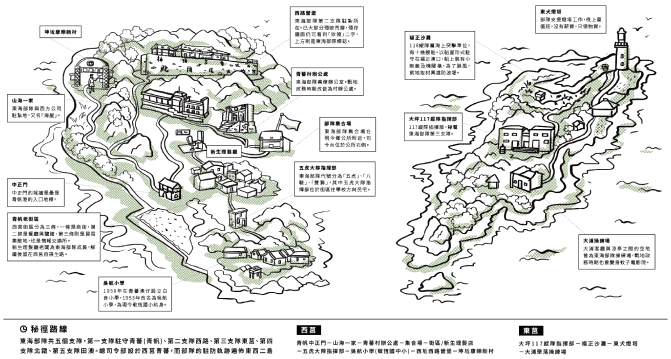
Juguang Township comprises two islands, Dongju and Xiju Islands. The township office is located on Xiju Island, although Dongju Island is slightly larger in area. Both Dongju and Xiju Islands are surrounded by sea on all sides, with numerous bays and harbors, making them rich in fishing resources. Dongju Island holds historical significance for Matsu, from the Chipinglong site from the Neolithic period, the Caiyuanli site for trade during the Tang and Song dynasties, to the Dapu stone inscription witnessing the Ming Dynasty's efforts against Japanese pirates. There's also the Dongquan Lighthouse guiding international ships after the Opium Wars, the Fukcheng and Dapu settlements formed by immigrants from eastern Fujian in the late Qing and early Republic of China period, as well as the military fortifications spread throughout during the Chinese Civil War and the rise of the Daping Village due to consumption by soldiers... Everywhere you look, you can see traces of history.
Xiju Island has three villages: Qingfan, Tianwo, and Xipin. Qingfan, formerly known as Qingfan, was a commercial area, settlement, and port. In the first half of the 20th century, it was the most prosperous place in Matsu and the only place designated as a "town." Since the end of the Qing Dynasty's five-port trade, with Chinese and foreign ships entering the Minjiang River, they needed to wait for the tide, seek shelter from the wind, and replenish freshwater at the mouth of Qingfan Bay. Under the barter trade, Chinese and foreign goods circulated in the market. Perhaps due to the appearance of foreigners, the locals originally referred to this bay as "Qingfan," and it was later renamed "Qingfan." In the early 1950s, Western companies from the United States stationed on Qingfanshan, and the American flag once flew here for a period.
Tianwo Village was initially a traditional settlement with a semi-agricultural and semi-fishing economy. In 1969, the Nationalist Army built the Zhongzheng Hall Cinema here, which once boosted the surrounding economy with military consumption but later declined due to the withdrawal of troops. Xipin Village is located on the west side of Xiju Island, with higher terrain and better visibility. Looking westward, one can see Meihua Town in Changle County, mainland China, and looking south, one can see Pingtan Island, capturing all movements and sounds. The Donghai Guerrilla Squad once established "Kangle New Village" in Kunping.
Footprints of the East Sea Force Guerrilla Activities: Points of Observation

Zhongzheng Gate
Qingfan Port serves as the gateway to Xijudao, and following the establishment of the East Sea Force, Zhongzheng Gate and the surrounding walls were constructed, making it the most significant landmark in Xijudao. Zhongzheng Gate has stood since 1950, undergoing several renovations over the years, yet retaining its basic outline. Among old photographs, the most notable aspect is the evolution of slogans on the walls at different times, reflecting changes in the situation.


Mountain and Sea Family
Mountain and Sea Family is the most iconic building in Qingfan Village, as it used to be the headquarters of the East Sea Force and the residence of the Western Company, its historical significance is self-evident. However, in reality, the image of the cemented white house that most people remember as Mountain and Sea Family is not the scene of historical events at that time. It is discovered from old photographs that the original Mountain and Sea Family was a brick-built wooden structure.


Extended Reading
- On June 3, 1994, on the 45th anniversary of the founding of the East Sea Force, Wei Geng, the commander of the 119th Regiment of the East Sea Force, organized the establishment of the "East Sea Association." In 1998, "The Struggle History of the East Sea Force" was published.
- In 2005, Mr. He Shunbao, the chief of staff of the Assault Army, and his descendant Mr. He Xiaosong completed the book "East Sea Waves: A Shadow Force Used by the CIA."
- In 2017, the Matsu Cultural Affairs Bureau invited East Sea veterans to revisit. Writer and historian Liu Hongwen interviewed the veterans and wrote "Looking Back at White Dog: East Sea Veterans' Journey to the Island," published on the Matsu's website, "Voice of Matsu" (https://voiceofmatsu.com/).
