Daqiu Island is not just about sika deer.
Dajiao Island, located north of Beigan Island, was originally an obscure little island, but it has become one of the hottest tourist attractions in Matsu in recent years due to an unexpected group of adorable guests - Formosan sika deer. Known as the "Dajiao Ecological Paradise," comparable to Nara, Japan, tourists are immediately surrounded by a group of cute and friendly Formosan sika deer as soon as they step onto the Dajiao Pier. These deer skillfully wait for visitors to feed them, and many tourists spend half a day on Dajiao Island, primarily around the pier, during their island-hopping journey.
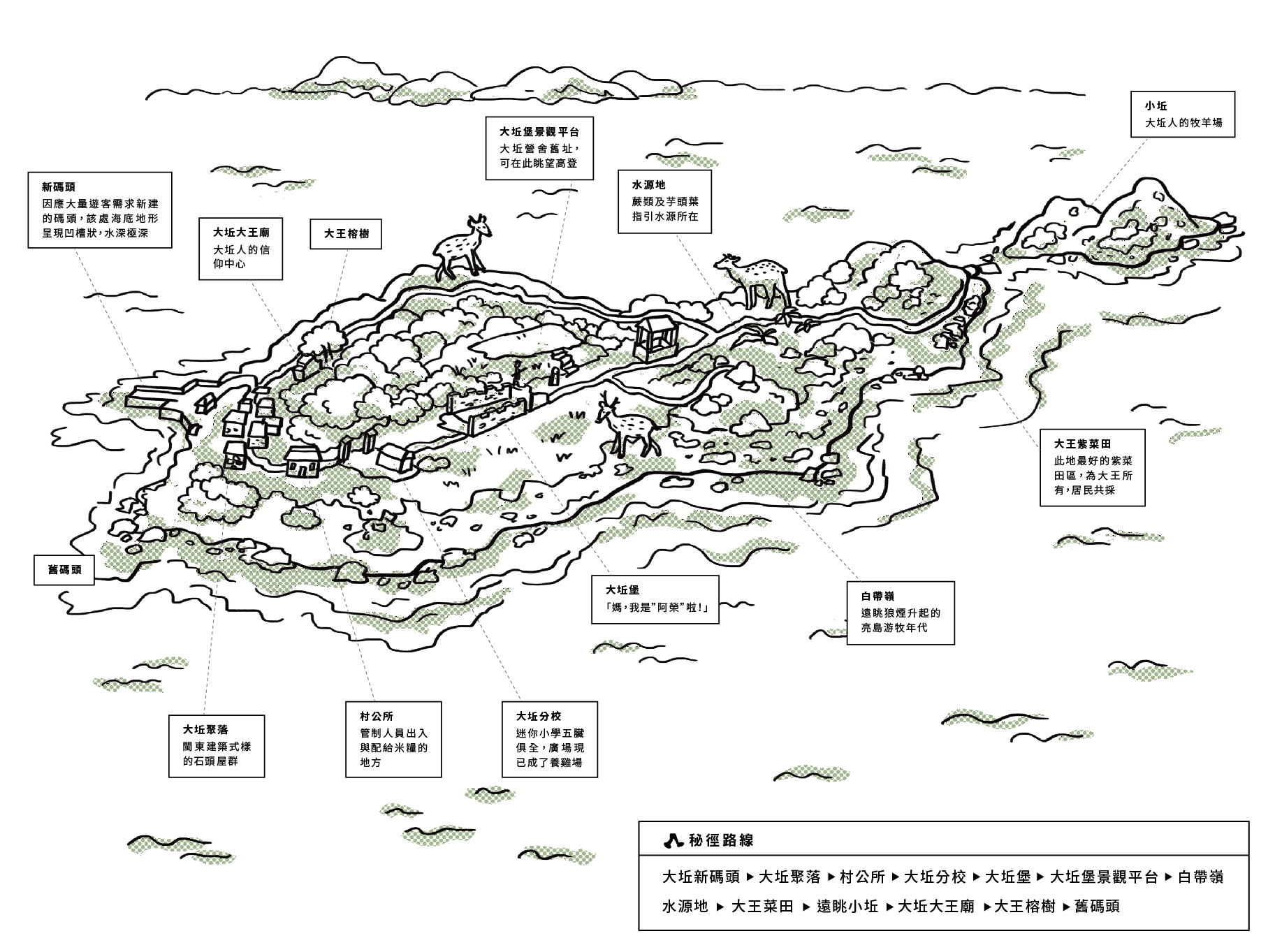
However, the Formosan sika deer are actually just a serendipitous occurrence in the long history of Dajiao. If we shift our focus away from the deer, looking from the old pier, we can see a settlement composed of stone old houses. Moving further up, there's a mini-schoolhouse now occupied by a flock of chickens quietly nestled. This is followed by the towering Dajiao Fortress with soldier statues and a lush Dajiao Warrior Platform. Further into the mountains, there are cultivated fields, abandoned buildings, water sources, and islands connected to Dajiao Island - Xiaojiao, Gaodeng, and Liang Island.
Walking around the steep slopes of Dajiao, you'll discover traces of past lives and the unique wartime ecology, with even herds of Formosan sika deer surviving on the island in their own way on distant mountain peaks. Dajiao is indeed much larger than you might imagine.

The Beautiful Surprise of Dajiao Island
The Formosan sika deer are actually newcomers to Dajiao Island. It wasn't until 1997 that they were "exiled" to Dajiao Island, which at the time was only inhabited by a small number of military personnel. The origins of the Formosan sika deer in Matsu trace back to 1980 when the county government used grassroots development funds to establish the Sannmin Livestock Farm at the foot of Qiugui Mountain in Nangan (now the site of the Haitan Factory), raising beef cattle. They received Formosan sika deer as a gift from the Taipei Zoo, initiating large-scale cattle and deer farming in the region. The primary purpose of raising Formosan sika deer was for studying their ecology, habits, and collecting antlers. Antler collection took place in July and August each year, with each deer yielding approximately fifteen taels of antlers per collection. In October 1986, deer antlers collected from the area were used to produce "deer antler wine."
In November 1992, the "Frontline Governance Experiment" in Kinmen and Matsu was terminated, and "self-reliance" was no longer the strategic principle at the front line. Matsu began importing frozen food from Taiwan, and the Defense Zone Forces established a "Secondary Food Supply Center," importing frozen chicken and pork on their own, making it difficult for the local livestock industry to compete, effectively putting an end to it. The thirteen Formosan sika deer raised at the Sannmin Livestock Farm became too costly to maintain, and the farm decided to cull them. However, when news of this reached the military authorities in Beigan, their intervention changed the fate of the Formosan sika deer.
After communication between the Beigan command and the county government, the Formosan sika deer were released onto Dajiao Island in January 1997, which had already reduced its military presence by half. Until the complete withdrawal of the military from Dajiao in 1998, Dajiao remained a true uninhabited island. Surprisingly, the Formosan sika deer left behind thrived in this environment, multiplying from thirteen to over a hundred, unexpectedly becoming a beautiful presence on Dajiao Island.
The Maritime Nomadic Lifestyle of Dajiao Islanders
In 1990, the last household on Dajiao Island relocated to Qiaozi on Beigan Island. Although just a stone's throw away, since then, the once lively fishing village on Dajiao Island only reappears during the Lantern Festival each year. Dispersed Dajiao Islanders gather at the religious center, the "Dajiao Great King Temple." Elders burn paper money while chanting, "Dajiao Great King, Xia Mu (Gaodeng) Great King, Sunyu (Xiaoku) Great King, Hengshan (Liang Island) Great King, please all come and enjoy." From this, it is evident that the survival domain of the Dajiao Islanders not only encompasses Dajiao and Xiaoku but also extends to strategic military sites such as Gaodeng, Liang Island, and surrounding reefs.
Before the arrival of the military, although settled on Dajiao, the islanders actually lived a maritime nomadic life, relying on collecting shellfish and mollusks. In the third month of the lunar calendar, as the marine resources became plentiful, the robust men and women of the island began preparing to migrate to "Hengshan (Liang Island)" to collect rattan pots. Hengshan was very remote, requiring a boat journey of 6 to 7 hours. Consequently, the islanders would construct temporary grass huts on Hengshan and reside there for about six months, while the older elders, children, and some women remained on Dajiao.
Following the Dragon Boat Festival in May and June of the lunar calendar, as the sea warmed up, coinciding with the end of the rattan pot season, the "razor clam" around Hengshan also became plump. Adult men dived into the sea to collect razor clams, while women collected "rock oysters" in the waters around Gaodeng. By the Mid-Autumn Festival, when the northeast monsoon began, signaling the end of the razor clam season, they would pack up the grass huts and living utensils on Hengshan, preparing to return home. They would sell the abundant harvest of the past six months, preserved and pickled, along the Fujian coast, exchanging them for daily necessities and offerings to thank the gods for their blessings throughout the year.
From the Lantern Festival to the beginning of autumn, the ongoing economic activity on Dajiao Island is the collection of seaweed. One-fifth of the island is the "Great King's Seaweed Field," owned by the Dajiao Great King, while other areas are freely accessible for collection. The "Great King's Seaweed Field" is located in the eastern waters of Dajiao Island, where the seaweed grows long and black, of particularly good quality. The day of the Lantern Festival is when the allocation of the "Great King's Seaweed Field" is determined by drawing lots. The time, scope, method of collection, and distribution are all based on the enduring agreements between the people of Dajiao and the Dajiao Great King, passed down through generations.

An Exceptional Place Amidst Preparedness
Located to the south of Daqiu Island lies Beigan, while to the north stands Gaodeng as a barrier, and further away is Liang Island, guarding. Therefore, compared to the warlike atmosphere presented by other islands, Daqiu exudes a peculiar tranquility. Even during the tensest times in cross-strait relations, Daqiu only had a reinforced platoon of about 50 soldiers stationed. There are no continuous coastal defense points on Daqiu Island; it only has the Daqiu Fortress, the Harbor Defense, and a point guarding the bridge channel next to the old pier. There are no underground defense facilities, and even air-raid shelters are rarely seen.
As a result, in the childhood memories of the people of Daqiu, regardless of gender, they naturally grew up close to the sea—swimming, diving, gathering shellfish, climbing cliffs, and even playing "treasure hunting" on the seabed. They would also watch TV and movies at the military camp in the Daqiu Fortress. Even during times of curfew, it seemed like an exception here. Furthermore, whenever there were air raids, instead of rushing to hide in bomb shelters, the people of Daqiu would watch the shells streak across the sky in front of their homes. Yet, there was an unknown fear in the thought, "Whose home will the shells hit today?" Watching from afar actually harbored an unknown fear.
After the national army was stationed in Mazu, it began to implement compulsory education with the goal of "establishing schools in every village and providing education for everyone." The Daqiu Branch School was established in 1952, a miniature school with only two classrooms, four grades, one dormitory, and one office. After completing the fourth grade, children from Daqiu had to either attend school at the Qiaozai or Tangqi Elementary School in Beigan, stay with relatives, or sleep in the school classroom. Saturdays were the most anticipated days for children, but whether they could return home smoothly depended on the availability of boats and favorable sea conditions. Independent living and watching the sea while waiting for boats were common experiences for the people of Daqiu during their schooling years.
Daqiu Island
Area Overview
Daqiu Island is located northwest of Qiaozai Village on Beigan Island, just 200 meters away. It is one of the islands under the jurisdiction of Beigan Township, with a land area of only 0.69 square kilometers. In the past, residents settled in the southern port area, forming a community. Due to the lack of a suitable harbor for larger ships, residents relied on gathering seaweed and shellfish for a living, moving between the surrounding waters of Gaodeng, Liang Island, and Xiaoqiu, leading a nomadic maritime life.
After the military arrived, although there were stationed troops on the island, its strategic location was not deemed crucial. As a result, there were only minimal defense facilities, and even the essential slogans seen on other Mazu islands were absent. This absence of a martial atmosphere preserved much of the island's natural character. Later, as residents and military personnel gradually left, Daqiu became an uninhabited island, providing a sanctuary for the Formosan sika deer.
In recent years, Daqiu has become a tourist hotspot again due to the Formosan sika deer, attracting a large number of visitors to the island in search of the deer. A restaurant and guesthouse have opened on the island, and former residents are considering returning to rebuild their homes. Additionally, plans are underway for a bridge to connect Qiaozai.

大坵,不只有梅花鹿 觀察重點


This Issue's Bonus Feature:
The Wild World of Sika Deer
Although sika deer may appear friendly and cute, they are not as docile as they seem. Especially during the rutting season in autumn, male deer can be particularly aggressive and combative. If there are more than two adult male deer in a herd, intense fights are inevitable, resulting in either mutual injury or the stronger deer driving the weaker ones out of the group. Therefore, the deer found alone around the pier waiting for food are often the losers of these battles. The true wild world of sika deer, where they can be observed from afar but not disturbed, lies in the mountains. Sika deer, which do not rely on human feeding, sustain themselves on the island's herbaceous plants, avoiding poisonous ones like Alocasia and Epipremnum.
