Entering the Sounds of Matsu
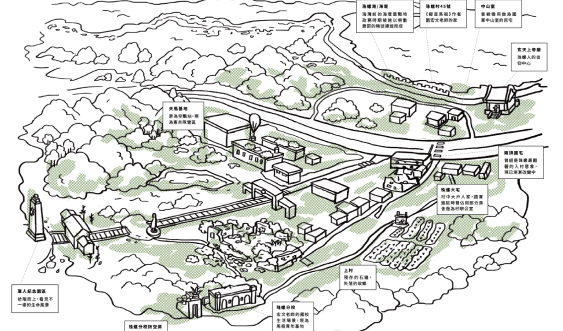
Located on the north side of Nangan Island, Zhuluo Village is a place name that seems to be nonexistent on the vast majority of tourist maps. However, once you come to Nangan and travel along the coastal highway between Qingshui and Magang, you'll encounter a section of road with speed bumps, flanked by blue, white, short cement houses on both sides, adjacent to the grand stone stairs and walls of the Military Memorial Park. Apart from the few households along the road, on the mountain side (upper village) and the seaside (lower village) separated by this road, stand houses built in different periods, inhabited by hundreds of residents. This is Zhuluo Village, a small village that is always slowly traversed and gently ignored.
However, the era experienced here, the stories that have occurred, will not disappear because of this. They are imprinted in the memories of the people of Zhuluo and vividly depicted in the writings of Professor Liu Hongwen, a native historian and writer from Zhuluo. Following the guidance of the essays in "Xiang Yin Matsu," we enter the pages of smoke, vitality, dispersal, retrospection, and family history, stepping into the living conditions and daily lives of island residents sandwiched between the straits on both sides; as literature and landscape intertwine, we enter the ever-changing seas and changes in personnel that belong to Zhuluo Village.

Local Sounds of Matsu
Literary Landscape Reference
Mr. Liu Hongwen, the author of "Local Sounds of Matsu," is from Zhu Luo, Nangan, Matsu. After graduating from Matsu High School, during the era of the outlying island recommendation system, he was inadvertently recommended to enter the chemistry department of National Taiwan Normal University. Leaving his childhood island, he later became a chemistry teacher and earned a doctoral degree in science education. After graduating from NTNU, he briefly returned to serve at Matsu High School before settling in Taiwan for work and life. After retirement, he resumed his passion for literature, dedicating himself to literary creation and historical research, returning to his beloved hometown in heart and pen.
Transitioning from chemistry to literature, Mr. Liu Hongwen's creative output remains prolific. His first published work, "Local Sounds of Matsu," contains thirty-two essays, including those set in Zhu Luo, such as "<Father>."
Farming Time on the Island
The formation of settlements in Aokou due to fishing activities is a major characteristic of the early settlers of Matsu; when we discuss the three stages of Matsu's development, it always starts with fishing. Although agriculture is not the primary economic activity, it was also one of the ways for residents to make a living on the island.
There were two important periods in the agricultural development of Matsu. The first was around 1939 to 1950, when due to the demand for opium in mainland China, residents began to cultivate poppy flowers. During the blooming season of poppies each spring, farmers would make an incision on the poppy fruit peel with bamboo strips, collect the white latex-like substance with bamboo tubes, and boil it to make black opium paste, which was sold to the mainland or local opium dens. This industry phenomenon was prevalent not only in Beigan but also among Zhu Luo residents.
The second period was after the outbreak of the Korean War in 1950 when the United States decided to resume military and economic aid to the Kuomintang government based on strategic considerations. The U.S. aid funds began to gradually modernize rural areas through the "Rural Restoration Commission," with Kinmen and Matsu being included as lifelines for supplying Taiwan and frontline bases for containing communist forces. Therefore, we can also see many traces of U.S. aid intervention in Matsu's farmland, such as irrigation systems and wells.

The Strong Winds of Military Administration
The arrival of the military and subsequent militarization had a profound impact on the landscape of Matsu, where every corner of the island, whether land, sea, or sky, was dedicated to military needs. Military outposts, barracks, facilities, and even spiritual symbols and slogans could be seen everywhere, rewriting the original spatial patterns and usage.
The most significant changes in Zhu Luo Village were the drastic alterations in living and production spaces due to the establishment of the "Military Cemetery" and the "Tianma Base." The "Military Cemetery" is now the "Military Memorial Park," built by the Matsu Defense Command in the central area of the settlement in 1950, featuring a chapel, plaza, stairs, archway, and monument. In 1968, the Ministry of National Defense instructed the Matsu Defense Command to establish the airborne station "Tianma Base" for conducting psychological warfare missions, with the site located on the hillside beside the entrance to the "Military Cemetery." The two-story white cement houses we see along the roadsides today were the residences provided by the military for the relocated households at that time.
On the other hand, the economic transformation driven by the military presence, mainly catering to military consumption, did not occur in Zhu Luo. Because the "Military Cemetery" and "Tianma Base" had only a small number of stationed troops, and the 94th Outpost Solid Fort and 01st Outpost Victory Fort stationed on both sides of Zhu Luo Bay were only of platoon size. Moreover, Zhu Luo was located between the Ma Gang and Shan Long commercial districts, with crowds flowing to both sides. Therefore, only three or four small white houses along the roadside engaged in military-related businesses, providing laundry services, daily necessities, and snacks for nearby soldiers. Most residents in the upper village, situated at a higher elevation, still primarily engaged in farming, bringing vegetables and fruits to sell at Ma Gang or crossing the mountain to sell them at the iron market. With the wave of population outmigration in 1970, residents gradually moved to Taiwan or more prosperous villages in Matsu. The upper village became increasingly desolate and is now known as the "Lost Hometown."
Zhu Luo Village in Nan Gan
Regional Focus
The naming of "Zhu Luo Village" comes from the rounded pebbles scattered throughout the Aokou Bay, which, with various colors and covered in seaweed, camouflage themselves to resemble the commonly seen mollusk "Zhu Luo" in the intertidal zone of the Matsu waters. Although Zhu Luo Village is also a coastal settlement, due to its gravel beach geological formation and the lack of sheltered harbors for wind and wave protection, it is not conducive for fishing boats to anchor ashore. Consequently, early residents turned to livelihoods in the mountains, cultivating terraced dry fields, planting melons and fruits in the summer, and switching to leafy vegetables in the winter.
In addition to fruits and vegetables, "Chaicheng" is also an important economic source for Zhu Luo. "Chaicheng" refers to a field of cogon grass, which burns vigorously in the furnace without needing to be dried, making it excellent fuel. Although cogon grass is wild, each "Chaicheng" has its owner, and one needs to pay rent to enter. In an era without coal balls or gas, relying solely on firewood for ignition, cogon grass became a valuable plant in the Zhu Luo region. Today, the ubiquitous cogon grass covering the hillsides adds a touch of desolation to Zhu Luo Village.

Entering the Sounds of Matsu: Key Observations
Pre-1950 Zhu Luo Village
Landmarks: Stone houses, Zhu Luo Bay, Gui Ao, Bitou Bay, Xuantian Temple
Industries: Terraced fields, Chaicheng (Cogon grass fields), Opium paste, Snail collecting


1950 / Nationalist Army's Occupation
Landscapes: Aukou fortified with tracks, wealthy households' stone houses occupied by the military, transformed into "Zhongshan Office" (Lower Village) and "Village Hall" (Upper Village); the Nationalist Army initiated the "One Village, One School" system, and tiny Zhu Luo was no exception.
Industries: Maintaining agricultural, Chaicheng, and snail-collecting lifestyles, albeit the opium paste business ceased operation and sales.


1960s: Military Cemetery, Coastal Defense Post, Air Raid Shelter
Landmarks: The military constructed a "Military Cemetery" in Shang Village and deployed coastal defense posts at the cape of Zhu Luo Bay.
Industries: Agriculture and snail collecting continued.

1970s: Tianma Base
Landmarks: Tianma Base (floating station), two rows of government housing (concrete houses)
Industries: Mostly agriculture and snail collecting; the two rows of government housing have two or three small shops providing daily necessities for the surrounding troops.


Further Reading
Apart from Professor Hongwen's "Sounds of Matsu," what other works can lead us to explore the literary landscape of Matsu? Here are some recommendations:
Literary Landscape of Original Hometown Matsu
"Lei Mengdi's Childhood in the Battlefield," by Chen Tianshun and Xia Shuhua. "Eyes Under the Sky," by Liu Zhilian.
Literary Landscape of Exotic Matsu
"That Year in the Contracted Teahouse," by Shu Chang. "Outer Island Books," by He Zhihe.
