Meishi Camp Officer's Special Teahouse
Introduction
Meishi Camp is located in the hub area of Nangan Island. In 1949, the Nationalist Army stationed on the islands and established a cultural center in Meishi, which then developed into a place for both military and civilian recreation and entertainment. The Meishi village transformed from a simple fishing village into a multifunctional military camp, holiday center, cinema, contracted tea house, and shopping street, becoming a healing place in the frontline of Matsu.
The Meishi Contracted Tea House on Nangan Island, Matsu, was established on October 3, 1957. The existing buildings of the officer-contracted tea house were built in 1959 and formally concluded in 1991. With the rise of awareness of preserving wartime culture, in 2018, the Cultural Affairs Department began planning and carrying out preservation, restoration, and reuse projects for the preservation of wartime sites. It is expected to be completed by the end of June 2021.
Space Introduction
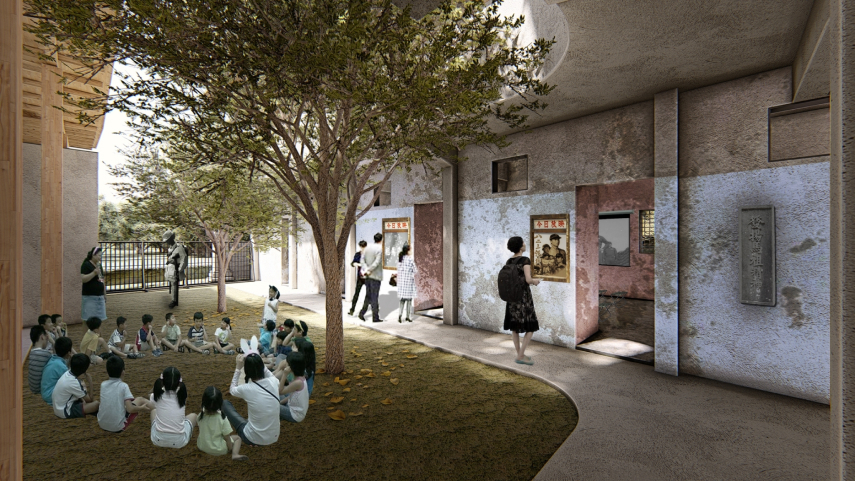
A cultural inn where history and the future coexist
To meet the future tourism needs of the camp, the project preserves the existing objects and atmosphere of the wartime site, creating a historic sense of the future through the coexistence of old and new.

未來示意圖↓


Exhibition Themes
Life in a Foreign Land
This section will recreate the ticket entrance, waitstaff, and military imagery memories, connecting the atmosphere of the Cold War-era Matsu, Meishi Camp, Meishi Market, and other spaces. Through situational storytelling, it will link the historical content related to the contracted tea house, reinterpreting and reconnecting the lost life experiences.
B1 Entrance Ticket - This will recreate the original scene of the ticket entrance and waitstaff number plates of the contracted tea house, including the price list at that time. It will also introduce the roles and tasks of the administrators at that time.
B2 Contracted Literature - It will introduce literary works or poems derived from wartime memories or culture, such as Shu Chang's "That Year in the Contracted Tea House," Sang Pin Dai's "Shore to Shore," Chen Chunmei's "Leaving the Green Tomb to the Twilight of Memory of Matsu Military Paradise," Liu Zhilian's "Eyes Under the Sky," and so on. Through these literary works' detailed descriptions, the public can better feel the wartime memories and the appearance of life on the battlefield at that time.
B3 Battlefield Soul Soothing - It will describe the feelings and emotions at that time from the perspective of soldiers in the first person. The narrative stories of three different background soldiers (unmarried adult men, married men, underage boys) will reveal the stories that happened in the contracted tea house in the past.
B4 - Flowers Blooming in a Foreign Land - Through the female perspective of the waitstaff, it will describe the hardships of working in Matsu at that time, homesickness, and stories of going shopping on the street.
B5 - Love Letters Under Fire - It aims to convey the love stories that occurred when soldiers and waitstaff met here, bringing out different endings. It hopes to present an open-ended conclusion, creating a space for quiet contemplation for the public.
B6 - Forbidden Secrets (18+ Special Exhibition) - Using artistic expression to present the emotional or spiritual gaps, complements, and entanglements of men and women on the battlefield at that time.
B7 - Silent Sky - During the Cold War, fires of war rose and fell everywhere, and many young men and women met, separated, or died on the battlefield. What did the war bring us? What did it change?
