Mythical Bird - Chinese Crested Tern
Matsu Islands Tern Refuge
After 1949, due to military needs of the time, some unpopulated islands of Matsu were often used as targets for shooting training; however, after the tension ended in 1992, these uninhabited islands were finally able to return to their natural state. Without human interference, they have become ideal breading grounds for seabirds.
The Chinese Crested Tern was officially named in 1863, approximately 140 years ago. The rare bird was last documented in 1937 in Qingdao, Shandong Province, China. At that time, a total of only 21 terns were recorded, including two which were later made into specimens, currently stored in the Herbarium of the Biodiversity Research Center of Beijing’s Chinese Academy of Sciences. Ever since the Chinese Crested Tern was named, there have been only five relatively certain recorded observations. There was once a period as long as 60 years when there was no reported sighting at all of the bird. With limited literature and description on the Chinese Crested Tern, it has come to be regarded as no less mysterious than the mythical creature of phoenix, and even nicknamed the "mythical bird" among international tern researchers.
Birds in the Matsu Islands Tern Sanctuary
- Mythical Bird - Chinese Crested Tern
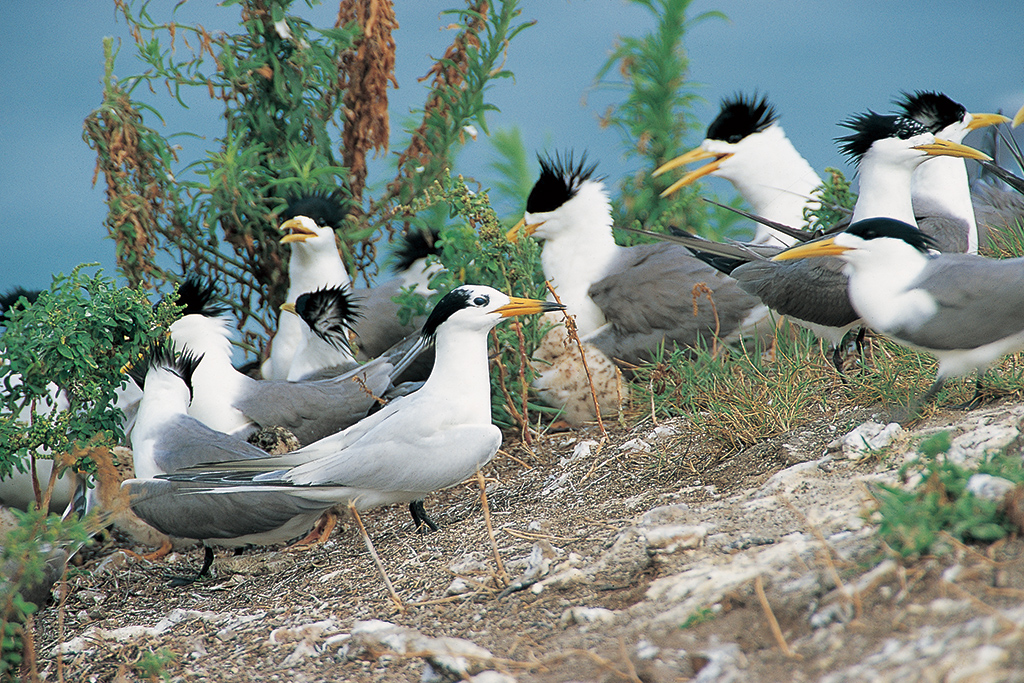
The Chinese Crested Tern, about 36 cm long, is a rare summer migrant bird. Its black-tipped orange beak serves as its most important identifying feature. The bird is black in the head with a crest, white in the forehead and chest, gray in the back all the way to the upper tail coverts, and gray white in wing feathers. When assuming its winter plumage, the top of their head becomes white.
Its forehead, which is usually white, turns black during courtship, and returns to white after brooding. When in a perching position, the tail feathers and wing tips are almost the same length. The tail feathers are gray and clearly forked. They fly alone or in pairs and inhabit coastal islands, estuaries, and harbors. They breed from April to September every year., feeding mainly on fish and shrimp.
The Chinese Crested Tern is one of the rarest in the bird family Laridae, which contains over 40 species. Since the tern’s naming in 1863, sightings of it have been few, leading researchers to dub it “the mythical bird."
- Black-tailed Gull (Larus Crassirostris)
On Dongyin Island, Black-tailed Gulls can be seen almost all year round, and they can be divided into several groups. There are the wintering group, transiting group, and breeding group. The breeding group on Dongyin is the only breeding Black-tailed Gulls in the nation. Also, Dongyi is what we now know as the southernmost reach for breeding Black-tailed Gulls in the world.
Of all the species in the bird family Laridae, Black-tailed Gulls are the only ones that nest. They pile hay into dish-shaped shallow nests in the crevices or on the small platforms of steep rock walls. A clutch usually consists of two to three eggs. The parent birds take turns brooding and feed the young by pre-chewing and regurgitating the food.
Both the local troops stationed in Dongyin and the famous Dongyin Kaoliang liquor adopt the Black-tailed Gulls in their designs. It is fair to say that the treasured seabird is the signature of Dongyin.
- Black-naped Tern
The Black-naped Tern is all white, except for its back (which is slightly gray) and legs and beak (which are black). Its most prominent feature is a black triangle on the back of its neck, hence the name, Black-naped Tern.
The terns do not build nests. Instead, they lay eggs on the flat or sunken areas of a rock or reef. A clutch consists of 2 to 3 eggs. The eggs are in colors that offer camouflage and protection. The parents usually start brooding immediately after the first egg is laid.
In order to prevent the eggs from rolling out of the nest, the parents will look for small stones near the nest, slowly throw them towards the nest, and then pile them around the eggs to form a recess in the middle so the eggs can stay put.
The Black-naped Tern is a rare wildlife species protected by the nation’s conservation laws. Despite the seabirds’ ubiquity on almost all of the islands in the Refuge area, the Black-naped Tern remains the smallest group in the Refuge area.
- Roseate Tern
The Roseate Tern is also called the Pink Tern because its chest and abdomen turn light pink during breeding season. Also, during this period, its beak, which is initially black, slowly turns red. The Roseate Tern lays 2 to 3 eggs in a clutch, and the eggs have good protective colors. Although the Roseate Tern is not listed as a protected species domestically, it is considered threatened and endangered internationally.
- Greater Crested Tern
The Greater Crested Tern is one of the larger birds in the genus Sterna. It is characterized by an erectable black crest, which resembles a fashionable Mohawk. The Greater Crested Tern breeds in colonies. They lay eggs disorderly on relatively open grassy slopes and lay one egg per nest. Even in such a densely populated breeding ground, the terns are still able to accurately locate their eggs. Contrary to the friendly, group-player association that people might make based on the bird’s habit to breed in colony, the terns are in fact often seen in argument with each other, even to the point of using their beaks as weapons. As it turns out, these crest-erecting squabbles arise out of their instinct to protect their eggs and fledglings.
- Bridled Tern
The Bridled Tern features a white forehead and eyebrow line, which when viewed from the front, looks like a V-shaped pattern, representing victory. During mating season, the male tern will provide food to the female, as all terns do. However, unlike other tern species, the male bird doesn’t bring food back in its beak. Rather, it chews the food and regurgitates it to the female. The parents also feed their chicks in this way. The Bridled Tern also lays one egg in one nest; however, it is more cautious in choosing a nesting location compared to other terns in the Refuge. The tern prefers more secluded places, usually in grass or in rock crevices where it digs out a hole on the ground for egg laying.